- Home
- Departments
- Water Quality Laboratory
- Chatham's Ponds
Chatham's Ponds
Kettle Ponds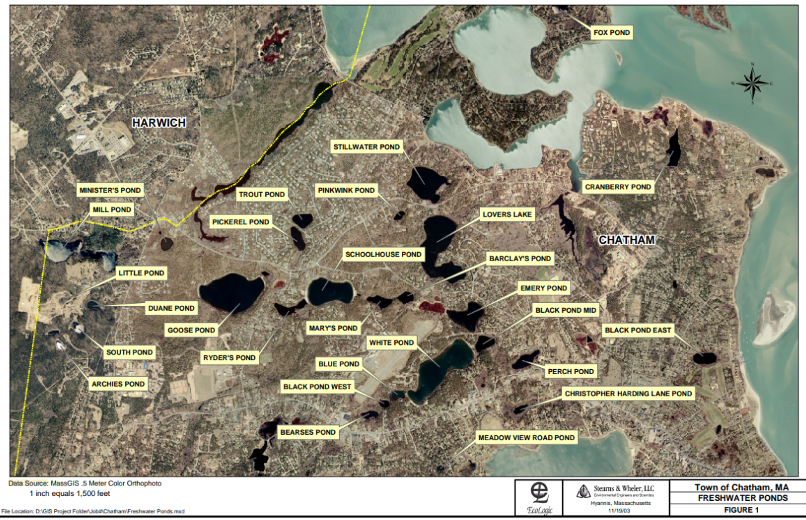
The ponds of Cape Cod are kettle ponds, formed as depressions left behind by ice blocks as the glacial ice retreated between 14,000 and 17,000 years ago. The ponds of Cape Cod have a common glacial origin, but their subsequent evolution differs based on the depth of the original ice block, landscape position relative to sea level, and the texture (particle size) of the soils in the ponds’ watersheds.
Cultural effects are also to be added to this list; the ponds of Cape Cod are influenced by development in the watershed, invasions of exotic species, alum treatments, application of lime to raise the naturally low pH of the waters, and fisheries management practices.
Unlike most lakes and ponds, kettle ponds do not have prominent tributary streams (inlets) and outlets. Groundwater seepage and direct precipitation, rather than surface water flows, are the source of water to the kettle ponds. The quality of the water in the ponds, therefore, is directly affected by the quality of the groundwater resource.
Programs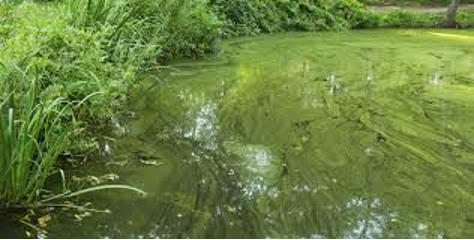
The Association to Preserve Cape Cod (APCC) Cyanobacteria Program is a great resource for information, videos, fact sheets, explanations, and a searchable map to find out information about the ponds on Cape Cod. While visiting the site, consider signing up for alerts by clicking the subscription button.
Another project by the APCC is the State of the Waters which provides information about water quality in saltwater embayments and freshwater ponds on Cape Cod.
The Cape Cod Commission (CCC) also hosts a Water Quality Data Portal that allows users to explore water quality data from across Cape Cod. The CCC also published Cape Cod Freshwater Pond Buffer Guidance to help homeowners and municipalities preserve and protect ponds through responsible landscape management.